D’Hanis
News of the WorldD’Hanis is the westward daughter community of Castroville where Jefferson Kyle Kidd delivers Johanna Leonberger to her relatives after her ransom from captivity. Its stone houses and St. Dominic’s church stand for an established Alsatian-German life, but the return exposes the difference between a place recognized as home and a home a child can inhabit. The community welcomes Johanna as one of its own; she experiences its language, household customs, and expectations as unfamiliar.
Setting and Community
D’Hanis lies fifteen miles west of Castroville, reached by a dusty caliche road across the flat country. The settlement belongs to a network of German-speaking communities whose residents live in villages and travel out to work their fields. Its life is visible in stone buildings and carefully tended land: the church and houses represent the labor of the people who made the community, while gardens carry seeds from the Huth Seed Company in Castroville. Peonies grow unusually large, as do the cabbages; the local welcome will later include Alsatian dishes alongside brisket prepared in the Texas style.
The churchyard of St. Dominic’s holds the graves of Wilhelm and Anna Leonberger and their little daughter. Before bringing Johanna to the family farm, Kidd takes her to the graves. He removes his hat and holds it to his breast, observing the respectful behavior he learned long ago. Johanna looks at the headstones and their weeping angels with curiosity but mostly indifference. Around her, the plowed land and stone buildings signal a settled European-style landscape; they do not make the dead familiar or the living feel like her own people.
Arrival and the Promised Homecoming
Kidd does not disclose the child’s captivity or her parents’ deaths to the people of Castroville before continuing toward D’Hanis. He expects that news would draw crowds bearing food and bedding, and that people would speak to Johanna in the Alsatian dialect. At the graves, she asks whether they are going back to Dallas and pleads with Kidd that she does not like the place. Her request makes the journey’s central problem plain: reaching her relatives is not the same as returning her to a life she recognizes.
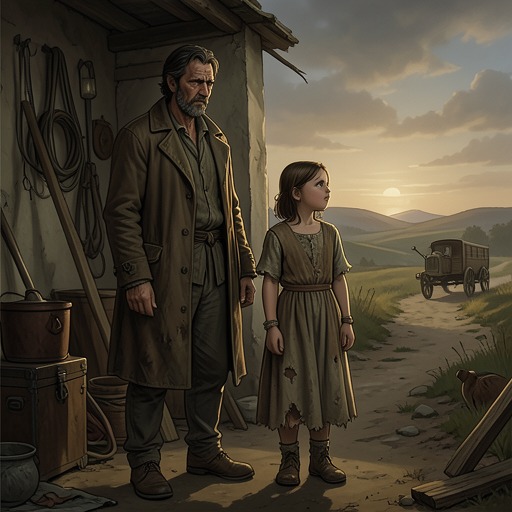
At the farm, the approach to reunion is abruptly concrete. The property has a stone house with a long galleria, a paling fence, chickens, farm tools, a barn, mesquite trees, and dogs barking around the arrivals. When a man drives the dogs away in German, Johanna’s head snaps up. She recognizes the language and whispers the words for aunt and uncle. The moment is a response to sound and relationship, not proof that the surrounding home has become familiar. Kidd introduces himself and explains that he has returned Wilhelm and Anna’s niece, ransomed by Indian Agent Samuel Hammond at Fort Sill in Indian Territory.
Welcome and Dislocation
News of Johanna’s return becomes a public celebration. Kidd understands that the relatives and neighbors will want to gather, praise the rescue, offer food, and test whether the girl remembers German words and her earlier childhood. In the farmhouse, however, Johanna crouches apart, studying objects the residents take for granted: daguerreotypes, patterned carpet, glass windows covered by drapes, and dishes displayed on a sideboard. To her, the metal plates and the fixed arrangement of household things are strange. The house’s familiar comforts to its owners are evidence of distance to the child who has lived elsewhere.
When the community comes to celebrate, Johanna retreats to the barn. She climbs the ladder and refuses to come down; when people climb partway up to speak German to her, she throws down a sickle and a barking spud. Kidd asks them to leave her alone for a while. The celebration honors a return that the adults understand as restoration, but Johanna’s flight and resistance show that communal affection cannot instantly undo captivity or the changes it has brought. D’Hanis’s welcome is sincere, yet its abundance of attention and expectation becomes another pressure on a child being asked to remember and perform an earlier identity.
Kinship, Obligation, and the Return
The limits of welcome are also institutional. The relatives have no adoption papers, and the messenger explains that formal adoption would make them legally responsible for Johanna’s support and, according to custom, for providing a dowry. They had not adopted a nephew. The issue is not simply whether the community claims her emotionally: kinship carries obligations of care and provision, and the family’s reluctance leaves the child’s place uncertain. Kidd recognizes the difficulty but feels unable to resolve it by argument or gratitude alone.
The next morning he drives away, then returns to the Leonberger farm at night, unsure whether the family will be glad to be rid of Johanna and worried that she may be made to work or beaten. From a mesquite grove he watches her cross the dark field alone to fetch the horses. She carries heavy leather halters and a wooden bucket of shelled corn; at ten years old, she struggles across uneven ground in the unfamiliar landscape, calling softly to the horses in Kiowa. This scene makes D’Hanis more than the destination of a rescue. It is the place where the claims of blood, community, law, and everyday care are tested against Johanna’s lived attachments—and where Kidd sees that being returned does not guarantee being protected or understood.